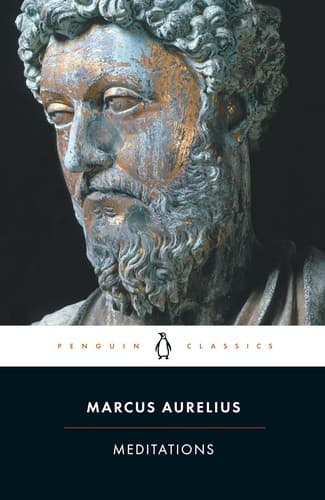

For most of February, I read Meditations on buses. Not by choice, exactly. It was the book in my bag, the traffic was what it was, and a paperback of short numbered passages turns out to suit a journey made of short numbered stops.
There is something fitting about it. Marcus Aurelius wrote these notes to himself, in Greek, while ruling an empire and, for long stretches, while living in military camps on the frontier. He never meant anyone else to read them. They are the private notebook of a busy, tired man trying to stay decent. I was a much less busy and only slightly less tired man, trying to stay decent between Farmgate and Mohakhali.
The same advice, again and again
The first thing you notice is the repetition. Marcus tells himself the same things over and over. Do not be angry at people; they are acting from ignorance. Do your work. Everything passes. Your judgement about a thing troubles you more than the thing itself.
On a first reading this can feel thin. Why say it ten times? By the second week I understood. He repeats it because he keeps forgetting, the way I keep forgetting. The book is not a lecture. It is a practice log.
One passage, near the start of the second book, has him telling himself each morning that he will meet people who are meddling, ungrateful and rude, and that he should not be surprised or harmed by it. I read that while a man's elbow rested on my shoulder for most of a kilometre. It helped. Not a lot, but enough.
A notebook for difficult days
The line I underlined most heavily was this: "The happiness of your life depends upon the quality of your thoughts." In the wrong hands, that becomes the kind of motivational poster that blames you for your own suffering. Marcus does not mean it that way. He is describing the one area where he has some control, in a life where he controls very little else, including plague, war and the deaths of his own children.
That distinction, between what is up to us and what is not, runs through the whole book. Traffic is not up to me. The conductor's shouting is not up to me. Whether I arrive at my meeting already furious is, at least partly, up to me.
Where it falls short
Meditations is not a warm book. There is a coldness in some passages, a tendency to describe the body and its pleasures with disgust, that I do not share and do not want. And there are moments when stoic acceptance starts to look too much like resignation to injustice, which is easy advice for an emperor to give himself.
It also helps to choose the right translation. Older versions can be stiff and archaic. Gregory Hays's modern English reads like real notes, which is what they are.
Why it stays in my bag
I finished the book in mid-March, but I have not taken it out of my bag. It is the right size for a short wait and the right length for a single stop. Opening it at random still works. Most days, the page I land on says something I needed to be told again.
প্রিয় অংশ
The happiness of your life depends upon the quality of your thoughts.