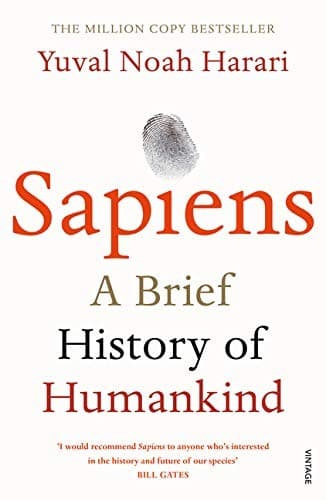

I do not usually write about a book before I finish it. It feels like reviewing a meal after the first course. But Sapiens is a book that keeps provoking small arguments in my head, and I want to write some of them down while they are still fresh, before the ending tidies them up.
I am roughly halfway through, somewhere in the long section on how money, empires and religions pulled scattered human groups into larger and larger networks.
The big claim
Harari's opening argument is simple and, once you see it, hard to unsee. Around 70,000 years ago, he suggests, something changed in the way our ancestors thought and spoke. They became able to talk about things that do not exist: spirits, tribes, laws, gods. And because they could believe the same stories, they could cooperate in numbers far larger than any group that relies on personal trust.
A chimpanzee troop works because everyone knows everyone. A city of millions works because everyone believes in the same invisible things.
His line about the monkey and the bananas is funny, and it is meant to be. But it carries the whole argument. No other animal, as far as we know, will give up something real today for a promise about something imagined.
The taka in my wallet
I read the chapter on money on a bus, with a few crumpled notes in my pocket, and it changed the way I looked at them. A five-hundred-taka note is a piece of printed paper. It has value only because the shopkeeper believes it does, and believes that the next person will believe it too. The whole economy of a country rests on that chain of trust, renewed thousands of times a minute, mostly without anyone thinking about it.
Harari calls these shared beliefs "imagined orders" and is careful to say that imagined does not mean false or useless. Nations, companies and human rights are stories, but they are stories that hold up bridges and feed people. Some of his examples, like the idea that a car company exists mainly as a legal fiction, are memorable precisely because they sound absurd until you think them through.
Where I am arguing back
The book moves very fast, and speed has a cost. Harari is fond of sweeping statements, and some of them deserve more caution than they get. His claim that the Agricultural Revolution was "history's biggest fraud", because farming made most individual lives harder even as it made our species more numerous, is a wonderful provocation. It is also a strong reading of evidence that specialists still argue over.
I keep writing "how do we know?" in the margin. Sometimes the next page answers. Often it does not, and I am left to decide how much I trust a confident narrator.
Why I am still reading
Because it makes me think, constantly, about things I had taken for granted. Few books manage that across hundreds of pages. Even when I disagree, the disagreement is useful. It sends me looking for other books, which may be the best thing a popular history can do.
I will write again when I finish, probably with a different opinion. For now: no rating, a lot of pencil marks, and a growing list of questions.
প্রিয় অংশ
You could never convince a monkey to give you a banana by promising him limitless bananas after death in monkey heaven.