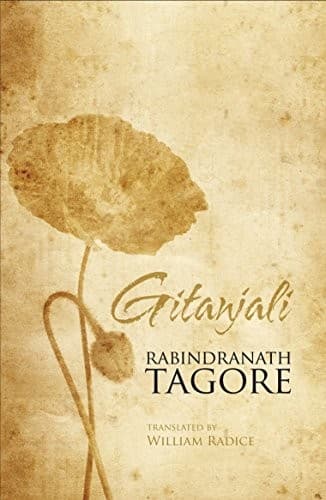

I finished Gitanjali again in September, which is a strange thing to say about a book I have never really finished. It is the kind of book you close rather than complete. You reach the last poem, sit for a minute, and then open it somewhere in the middle.
This time I read it slowly on purpose: one poem in the morning, before the phone, and nothing more from it until the next day. It took a little over three months. I recommend the method to anyone, and I want to explain why.
The book that is really two books
There is a small confusion at the heart of Gitanjali that is worth knowing before you start. The Bangla Gitanjali, published in 1910, is a collection of songs. The English Gitanjali, which Tagore translated himself and which carried him to the Nobel Prize in 1913, is something else: a sequence of 103 prose poems drawn from that book and from several others.
So when an English reader and a Bangla reader both say they love Gitanjali, they may not be talking about the same pages. I have come to think this is a gift rather than a problem. The book lives between two languages, and you can stand in either one and look across.
Poem 35, again
Most of us met poem 35 as a recitation piece. "Where the mind is without fear and the head is held high" is painted on school walls and read aloud at prize-givings, and repetition does what it always does. It sands the words smooth until you can say them without hearing them.
Read slowly, on its own morning, the poem is not comfortable at all. It is a list of conditions, and each one is a quiet accusation. Knowledge that is free. A world not broken into fragments by narrow domestic walls. A clear stream of reason that has not lost its way in the desert sand of dead habit. I read that last image twice and thought about my own habits, which are not always dreary but are certainly dead in places.
The original, চিত্ত যেথা ভয়শূন্য, comes from an earlier collection, Naivedya. In Bangla it has the rhythm of a song you could walk to. In English it reads more like a prayer said with the eyes open. I am glad to have both.
What the English loses, and what it keeps
Tagore's English is plain, almost scriptural, and some readers find it flat after the music of the Bangla. They are not wrong. The rhyme goes, and so does the play of sound that makes his songs easy to carry around in the body.
What survives is the stance. The poems speak to someone who is near and not quite visible. The speaker waits, lights a lamp, wakes to find that a visitor came and sat beside him while he slept. Read in a row, these small domestic scenes add up to something larger: a whole way of waiting, built out of ordinary rooms and doorways.
How I read it this time
A few habits made this reading different from the earlier ones:
- One poem a day, and no skipping ahead when a poem seemed thin.
- A pencil, but only for marking lines, never for notes in the margin.
- Reading the matching Bangla song when I could find it, then going back to the English.
The third habit mattered most. It slowed me down further and reminded me that translation is a decision, made line by line, by a poet who knew exactly what he was giving up.
Who it is for
If you think poetry is not for you, start here. The poems are short, the language is simple, and nothing depends on knowing the tradition behind them. If you read it once in school and filed it away, take it off the shelf. It will have changed, because you have.
I gave it five stars, which feels a little silly, like rating the monsoon. But I would hand this book to almost anyone, and I cannot say that about many.
Highlights
Where the mind is without fear and the head is held high